
The Three Pillar Matrix for Your Career
A practical framework for assessing professional fit, growth conditions, and the structural strength of your current career foundation.
All articles
The Three Pillar Matrix for Your Career
Career Reflection with Structure
Many professionals and leaders ask themselves similar questions throughout their careers: Am I with the right employer? Does my role truly fit me? Is my contribution seen and valued? Am I developing, or standing still?
Even when the internal answer is clear, the next step often does not follow. This is rarely due to lack of clarity, but rather the absence of a structured way to assess the situation objectively and derive a disciplined decision.
That is precisely the purpose of the Three Pillar Matrix. It is intentionally simple, yet highly disciplined in application. The prerequisite is honesty in self-evaluation. Not every dissatisfaction is automatically an employer issue, and not every sense of loyalty is automatically a sound strategy.
Core Idea
The matrix combines two levels:
- Level One A–C: fit, development, and contribution
- Level Two D–F: environment, prospects, and package conditions
The result produces an outcome between 0 and 3, indicating the structural strength of your current professional foundation.
Step 1: Level One A–C
Evaluate each question with 1 for Yes and 0 for No.
A. Satisfaction and Structural Fit
Are you satisfied with your current role and aligned with the organization’s structure? This refers not to occasional good days but to the overall fit, including communication culture, leadership style, HR practice, workload expectations, work–life balance, and team environment.
B. Development and Capability Growth
Is your employer visibly investing in your development and capability growth? Assess objectively whether you have progressed professionally or methodologically in the last 12 to 24 months.
C. Business Contribution
Are you making a clear contribution to the organization’s business and objectives? The key question is whether your contribution is measurable, transparent, and relevant in the broader context.
Step 2: Level Two D–F
Evaluate each question with 1 for positive and 0 for negative.
D. Work Environment
Is the environment professional, respectful, capable, and motivating?
E. Development Prospects
Are there realistic opportunities for growth, greater responsibility, new challenges, training, or visibility?
F. Compensation and Overall Package
Are salary, bonus, benefits, and the overall package broadly appropriate from your perspective?
Step 3: Calculation
Combine A–C with D–F. The principle is intentionally simple in order to remain understandable and practical. Insert the values according to your responses and derive the resulting pillar strength.

Step 4: Result and Interpretation
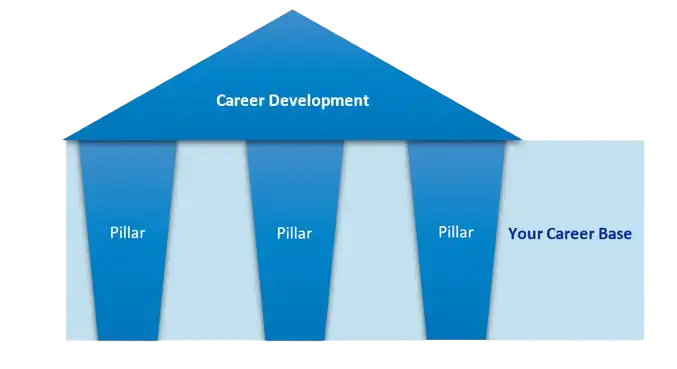
The outcome ranges from 0 to 3. Interpretation follows a simple scale that visualizes the structural strength of your current career base.

Step 5: The Three Pillar Model as a Mental Framework
Consider your professional situation as a structure supported by pillars. Three stable pillars create a robust foundation. Two pillars provide support but remain vulnerable. One pillar is unstable. Without structural support, the situation becomes fundamentally unhealthy.
Interpretation of Results
Result 0
This indicates the absence of a viable foundation. Typically, it signals the need for reorientation. The central question becomes not whether to change, but how and within what timeframe.
Result 1
A single supporting pillar is rarely sustainable. Pressure, frustration, or stagnation often lead to forced decisions. In this configuration, developing an active transition plan is advisable.
Result 2
Two pillars suggest underlying stability, yet one element required for long-term sustainability is missing. A structured discussion with your employer is the appropriate next step, aiming to strengthen the third pillar through clear agreements and realistic timelines.
Result 3
Three pillars indicate a solid foundation. Development is possible, performance is utilized, and conditions align. In such a situation, continuity is strategically sound.
Closing Reflection
The strength of the Three Pillar Matrix lies not in complexity but in clarity. It creates an objective perspective on an emotional question.
What number emerges for you, and what is the next disciplined step that follows?