
SMILE Strategy
Impact as a strategic leadership factor in the PDCA context
All articles
SMILE Strategy
Impact as a Strategic Leadership Factor in the PDCA Context
In performance-driven organizations, leadership is often defined through structures, processes, and metrics. Yet both management research and operational experience show that a central influence factor is frequently underestimated: the deliberate shaping of personal impact within the working environment.
Behavior, communication posture, and emotional signaling demonstrably influence decision quality, willingness to cooperate, and conflict dynamics. Research in organizational psychology shows that constructive interaction patterns reduce stress reactions, foster cognitive openness, and thereby enhance problem-solving capability and learning readiness. Studies from Harvard Business School and work on emotional intelligence by Daniel Goleman further demonstrate that leadership impact is significantly shaped by self-regulation and perception of others.
Against this backdrop, the SMILE Strategy was developed as a pragmatic action model to make impact consciously manageable while remaining compatible with established management processes.
Core Principle
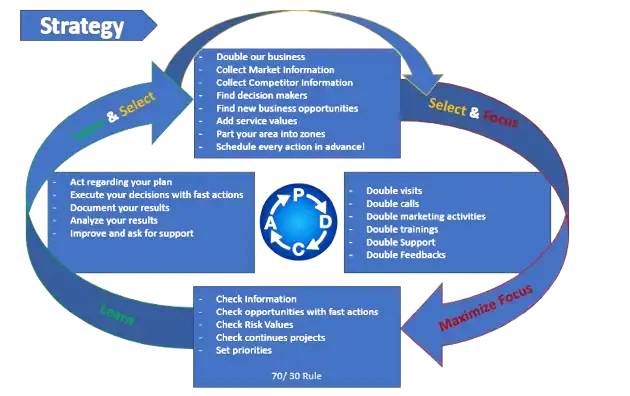
The SMILE Strategy is based on three clear action steps that are continuously repeated:
- Select
- Focus
- Learn
This structure connects behavioral discipline with decision discipline. The objective is not superficial positivity, but professional stability in conduct, particularly under pressure or in conflict-laden situations.
Select represents the deliberate choice of topic, objective, and conversational framework. Clarity reduces uncertainty and creates orientation.
Focus describes consistent alignment of execution with priorities. Behavioral discipline supports decision capability and reduces operational dispersion.
Learn stands for systematic reflection. Outcomes are analyzed, feedback is incorporated, and adjustments are derived.
This logic reflects insights from organizational learning theory by Argyris and Schön as well as principles of continuous improvement found in Lean management approaches.

Compatibility with Established Management Systems
In professional organizations, governance frequently follows the PDCA cycle. The global adoption of this model justifies retaining its English terminology:
- Plan
- Do
- Check
- Act
The SMILE Strategy is deliberately structured to allow direct alignment:
- Select corresponds to Plan
- Focus corresponds to Do
- Learn corresponds to Check
- Act integrates learned outcomes into the next cycle
This connection strengthens practical applicability because behavior is not treated in isolation but remains embedded within operational control processes.

Practical Application in Leadership Contexts
Combining SMILE Strategy with PDCA produces tangible organizational effects:
- Improved dialogue quality in coordination settings
- Greater commitment in decision-making
- Reduced emotional escalation
- Stronger learning culture after project phases
- More stable team cohesion under pressure
Empirical studies on transformational leadership show comparable outcomes among leaders with strong emotional self-regulation. Research from MIT Sloan Management Review likewise indicates that trust and communication quality correlate significantly with organizational performance.
Strategic Positioning
Impact is not a by-product of personality. It is a manageable element of professional responsibility. Leaders, advisors, and decision-makers continuously influence working climate, conflict intensity, and performance dynamics through their presence.
The SMILE Strategy provides a structured framework for shaping this impact deliberately without replacing methodological governance systems. Its strength lies in simplicity and immediate integration into existing decision cycles.
Concluding Perspective
Organizational performance emerges from the integration of expertise, structural clarity, and constructive interaction. Models such as the SMILE Strategy illustrate that behavior holds not only cultural significance but operational influence on outcome quality.
Conscious management of one’s personal impact is therefore not an optional soft skill but an integral part of professional leadership practice. The decisive question is not whether impact matters, but to what extent it is reflected upon and purposefully applied.