
Marketing Innovation and Competitive Advantage
Strategic differentiation in dynamic markets
All articles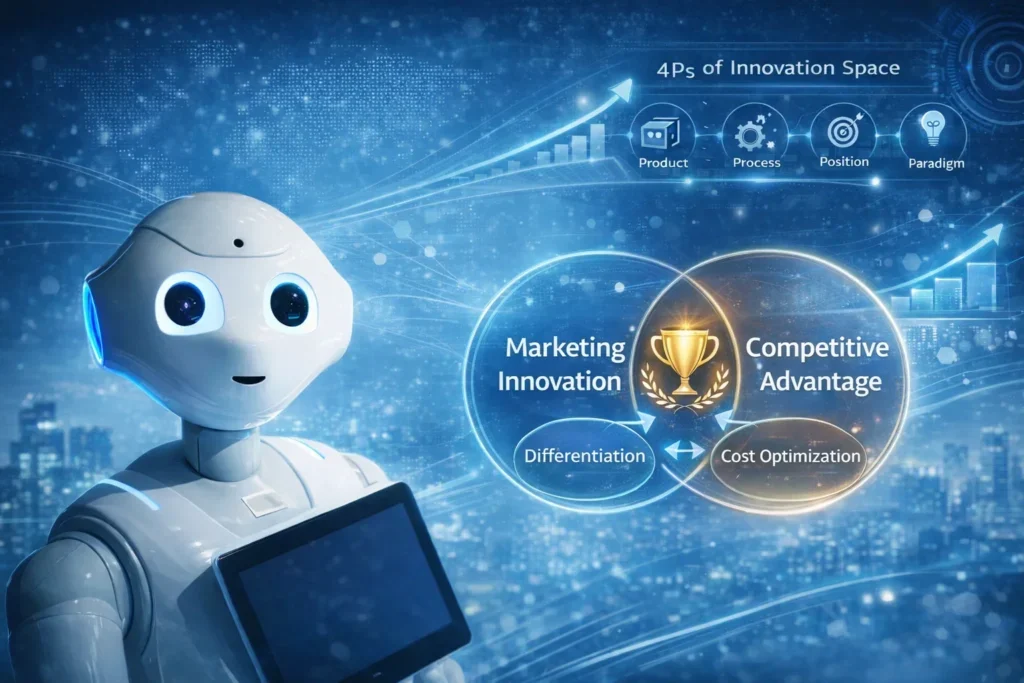
Marketing Innovation and Competitive Advantage
Strategic Differentiation in Dynamic Markets
In a volatile market environment, organizations face constant pressure to adapt. Sustainable business development requires not only operational efficiency but also the ability to create value across multiple dimensions simultaneously. Organizations must evolve business models, generate new demand impulses, secure liquidity, and maintain long-term customer attractiveness.
In this context, the terms marketing innovation and competitive advantage are often used in parallel, despite fulfilling distinct strategic functions. Clear differentiation supports more informed leadership decisions.
Marketing Innovation as a Transformation Instrument
According to the OECD definition, marketing innovation refers to the introduction of new marketing methods involving significant changes in design, placement, promotion, or pricing. The focus lies on adapting market interaction rather than on technological product innovation itself.
Marketing innovation serves strategic positioning and may enable, for example:
- Expansion of target audience reach
- Strengthening of brand perception
- Adjustment of pricing logic
- Redesign of customer experience
A well-known example is IKEA, whose combination of product design, self-assembly concepts, and digital visualization through augmented reality applications reshaped the entire purchasing process. Such approaches demonstrate that marketing innovation must not be viewed in isolation but as a systemic component of the value chain.
Research by Scott and findings from the Oslo Manual underline that marketing innovation can produce measurable effects on brand perception, customer satisfaction, and market penetration.
Competitive Advantage as a Strategic Outcome
Barney defines competitive advantage as a situation in which an organization implements a value-creating strategy that cannot simultaneously be replicated by competitors. Competitive advantage therefore describes not a measure, but its outcome.
Strategic competitive advantages may arise through:
- Technological differentiation
- Cost leadership
- Service integration
- Brand access
- Ecosystem lock-in
Apple illustrates this through the combination of product design, platform integration, and brand loyalty. Innovation cycles alone do not create advantage. The decisive factor is the ability to make resources and capabilities difficult to imitate over time.
The Resource-Based View and Porter’s work show that sustainable advantages emerge primarily from unique organizational capabilities.
Interaction Between Both Concepts
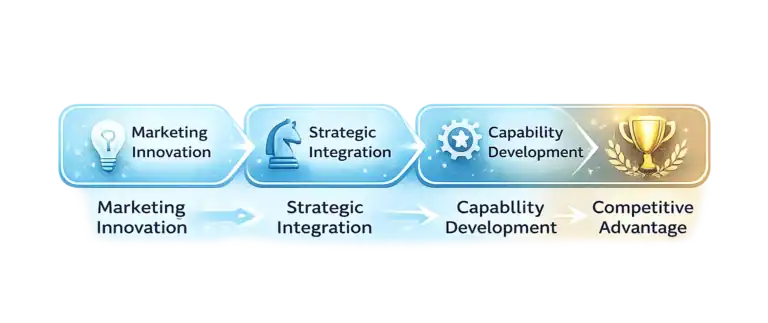
Marketing innovation is not a substitute for competitive advantage but often acts as its catalyst. While innovation creates options for action, strategic integration determines their long-term effect.
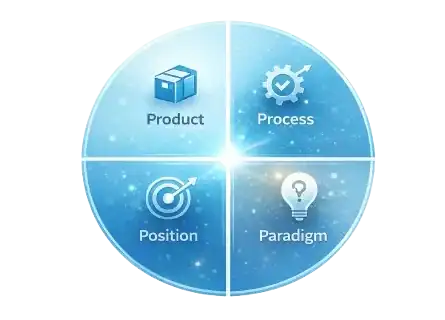
The 4P innovation model distinguishes product, process, position, and paradigm as domains of change. Marketing innovation operates within these domains and supports differentiation or cost optimization in line with generic competitive strategies.
Samsung demonstrates this interaction. Technological differentiation through camera innovation was translated into market perception through adjustments to user interface and communication strategy. Only the integration of both levels generated competitive impact.
Studies by Crick and Chen confirm that isolated innovation rarely produces lasting market shifts. Impact emerges through integration into overall strategy.
Strategic Importance in Economic Transition Phases
During periods of economic uncertainty, organizations tend to prioritize short-term liquidity over long-term development. Yet these phases often provide room for structural innovation, as operational utilization may decrease and transformation windows emerge.
Long-term competitiveness is built on continuous development of organizational capabilities. Marketing innovation can serve as a lower-risk entry point, while strategic competitive advantages are built progressively.
Research on organizational resilience shows that companies maintaining continuous innovation orientation respond faster to market changes and achieve more sustainable growth.
Concluding Perspective
Marketing innovation and competitive advantage are not competing concepts but represent different levels of strategic development. Innovation expands strategic options, while competitive advantage secures their lasting impact.
Organizations that manage both dimensions in an integrated manner build structural resilience against market dynamics. What matters is not the isolated application of individual instruments, but their systematic embedding within strategic leadership.
Long-term success arises from the consistent development of organizational capabilities rather than from short-term optimization of individual measures.