
Business Development as a Strategic Integration Function
Role, tensions and long term impact
All articles
Business Development as a Strategic Integration Function
Role, Tensions, and Long-Term Impact
Over the course of many careers, it becomes evident that the term business development is interpreted differently across organizations. A consistent definition rarely exists. While the structural core idea remains comparable, the scope of responsibilities, sphere of influence, and level of operational integration vary significantly. Studies by McKinsey indicate that cross-organizational growth functions are embedded differently in more than 60 percent of companies, which can lead to role ambiguity and inefficient resource allocation.
From a strategic perspective, business development can be understood as the collective set of operational and strategic initiatives aimed at improving an organization’s capabilities, market position, and value creation. This interpretation aligns with Ansoff’s work on strategic corporate development, as well as more recent research on growth governance through integrative management functions.
Cross-Organizational Impact
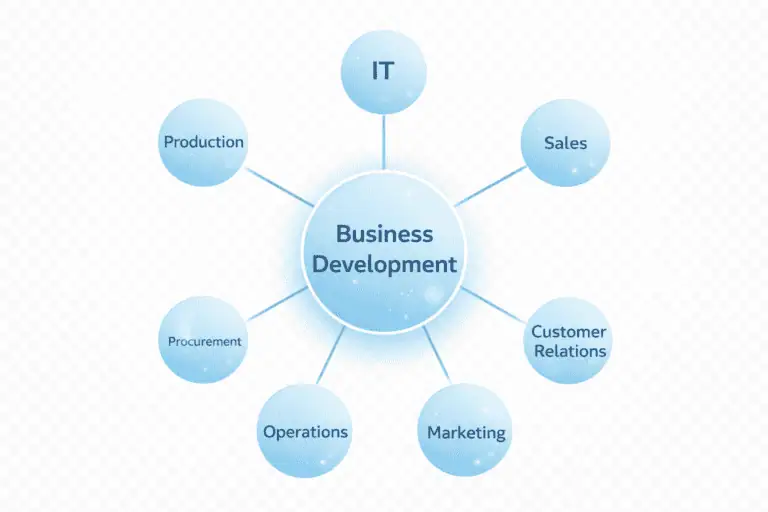
Business development rarely operates in isolation. Its effectiveness emerges through organization-wide interaction. In practice, it touches nearly every functional area. Research on cross-functional integration shows that companies with strong interdisciplinary alignment achieve significantly better innovation outcomes and market-entry performance.
An analysis published in the Harvard Business Review indicates that organizations with well-integrated strategic growth functions can increase the success probability of new initiatives by up to 30 percent. This positioning, however, also creates structural tensions, as intervention in established responsibilities may trigger resistance.
Requirements for Effective Business Development Practice
The role demands structural thinking, simultaneous analytical capability, and decisiveness. Business development operates within complex dependencies and multiple uncertainties. Studies on strategic decision-making show that leaders with strong systemic thinking capabilities are significantly more successful in navigating dynamic markets.
Effective practice typically manifests through:
- Interdisciplinary analysis
- Risk assessment
- Stakeholder coordination
- Communicative integration
- Execution of strategic initiatives
Research into competency profiles for strategic roles suggests that these capabilities correlate more strongly with experience and cognitive integration capacity than with formal training programs alone.
The Challenge of Long-Term Orientation
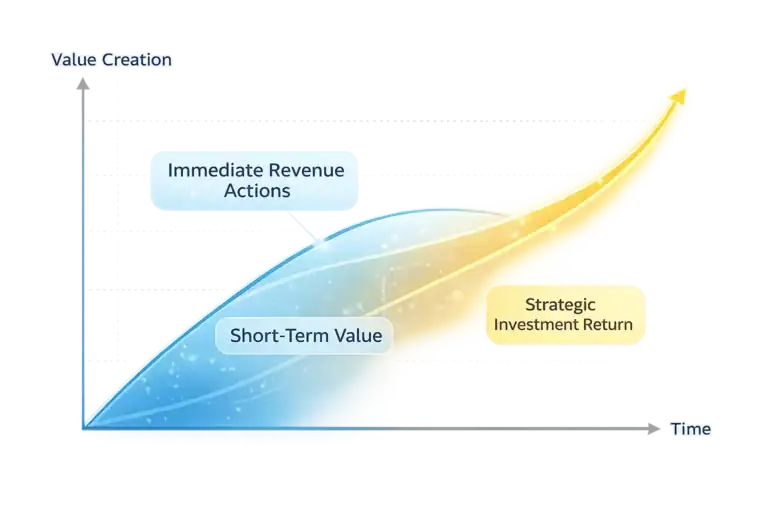
One of the central challenges lies in the tension between short-term revenue pressure and long-term value creation. PwC studies show that more than 70 percent of executives view short-term financial targets as the primary barrier to long-term investment decisions.
At the same time, research on strategic planning demonstrates that long-term initiatives are critical to sustainable competitiveness. According to Boston Consulting Group findings, organizations with structured innovation portfolios generate above-average long-term returns.
Effective business development must therefore address both time horizons simultaneously and make decisions under uncertainty.
Integration Capability as a Success Factor
Effective business development connects past, present, and future perspectives of an organization. Analyses from MIT Sloan Management Review indicate that trust, transparency, and cross-functional cooperation are core success factors for transformation initiatives.
Execution typically rests on:
- Organizational trust
- Cross-functional cooperation
- Clear transparency of objectives
- Decision capability
- Acceptance of learning processes
Missteps are inherent to transformation work. Organizations with strong learning capacity demonstrably exhibit greater resilience to market dynamics.
Concluding Perspective
Business development is not an isolated function but a connective element of strategic organizational evolution. Its impact arises through integration, diversity of perspective, and execution capability.
The role continuously operates between influence and resistance, between vision and operational reality. It is precisely this tension that positions business development as a key driver of sustainable growth.
The value of the function lies not solely in the initiatives it generates, but in its capacity to enable structural development over the long term.